 Add to Chrome
 Add to Firefox
 Add to Edge
The Essence of Balance for Self-Improving Agents in Vision-and-Language Navigation
Apr 21, 2026
In vision-and-language navigation (VLN), self-improvement from policy-induced experience, using only standard VLN action supervision, critically depends on balancing behavioral diversity and learning stability, which governs whether the agent can extract a reliable learning signal for improvement. Increasing behavioral diversity is necessary to expose alternative action hypotheses but can destabilize policy-induced learning signals, whereas overly conservative stability constraints suppress exploration and induce early commitment, making reliable self-improvement difficult. To address this challenge, we propose Stability-Diversity Balance (SDB), a plug-and-play mechanism for balanced self-improvement in VLN. SDB expands each decision step into multiple latent behavioral hypotheses by applying controlled shifts in the instruction-conditioned hidden states, and then performs reliability-aware soft evaluation and aggregation to retain diverse yet instruction-consistent alternatives during learning. An explicit regularizer further constrains hypothesis interactions, preventing excessive drift or premature collapse of hypothesis diversity and stabilizing self-improvement without discarding training signals. Experiments on R2R, SOON, and REVERIE show consistent improvements; for example, on REVERIE val-unseen, SDB improves SPL from 33.73 to 35.93 and OSR from 51.07 to 54.25.

Instruction-as-State: Environment-Guided and State-Conditioned Semantic Understanding for Embodied Navigation
Apr 20, 2026Vision-and-Language Navigation requires agents to follow natural-language instructions in visually changing environments. A central challenge is the dynamic entanglement between language and observations: the meaning of instruction shifts as the agent's field of view and spatial context evolve. However, many existing models encode the instruction as a static global representation, limiting their ability to adapt instruction meaning to the current visual context. We therefore model instruction understanding as an Instruction-as-State variable: a decision-relevant, token-level instruction state that evolves step by step conditioned on the agent's perceptual state, where the perceptual state denotes the observation-grounded navigation context at each step. To realize this principle, we introduce State-Entangled Environment-Guided Instruction Understanding (S-EGIU), a coarse-to-fine framework for state-conditioned segment activation and token-level semantic refinement. At the coarse level, S-EGIU activates the instruction segment whose semantics align with the current observation. At the fine level, it refines the activated segment through observation-guided token grounding and contextual modeling, sharpening its internal semantics under the current observation. Together, these stages maintain an instruction state that is continuously updated according to the agent's perceptual state during navigation. S-EGIU delivers strong performance on several key metrics, including a +2.68% SPL gain on REVERIE Test Unseen, and demonstrates consistent efficiency gains across multiple VLN benchmarks, underscoring the value of dynamic instruction--perception entanglement.
Dual-Anchoring: Addressing State Drift in Vision-Language Navigation
Apr 19, 2026Vision-Language Navigation(VLN) requires an agent to navigate through 3D environments by following natural language instructions. While recent Video Large Language Models(Video-LLMs) have largely advanced VLN, they remain highly susceptible to State Drift in long scenarios. In these cases, the agent's internal state drifts away from the true task execution state, leading to aimless wandering and failure to execute essential maneuvers in the instruction. We attribute this failure to two distinct cognitive deficits: Progress Drift, where the agent fails to distinguish completed sub-goals from remaining ones, and Memory Drift, where the agent's history representations degrade, making it lose track of visited landmarks. In this paper, we propose a Dual-Anchoring Framework that explicitly anchors the instruction progress and history representations. First, to address progress drift, we introduce Instruction Progress Anchoring, which supervises the agent to generate structured text tokens that delineate completed versus remaining sub-goals. Second, to mitigate memory drift, we propose Memory Landmark Anchoring, which utilizes a Landmark-Centric World Model to retrospectively predict object-centric embeddings extracted by the Segment Anything Model, compelling the agent to explicitly verify past observations and preserve distinct representations of visited landmarks. Facilitating this framework, we curate two extensive datasets: 3.6 million samples with explicit progress descriptions, and 937k grounded landmark data for retrospective verification. Extensive experiments in both simulation and real-world environments demonstrate the superiority of our method, achieving a 15.2% improvement in Success Rate and a remarkable 24.7% gain on long-horizon trajectories. To facilitate further research, we will release our code, data generation pipelines, and the collected datasets.
Task-Guided Prompting for Unified Remote Sensing Image Restoration
Apr 03, 2026Remote sensing image restoration (RSIR) is essential for recovering high-fidelity imagery from degraded observations, enabling accurate downstream analysis. However, most existing methods focus on single degradation types within homogeneous data, restricting their practicality in real-world scenarios where multiple degradations often across diverse spectral bands or sensor modalities, creating a significant operational bottleneck. To address this fundamental gap, we propose TGPNet, a unified framework capable of handling denoising, cloud removal, shadow removal, deblurring, and SAR despeckling within a single, unified architecture. The core of our framework is a novel Task-Guided Prompting (TGP) strategy. TGP leverages learnable, task-specific embeddings to generate degradation-aware cues, which then hierarchically modulate features throughout the decoder. This task-adaptive mechanism allows the network to precisely tailor its restoration process for distinct degradation patterns while maintaining a single set of shared weights. To validate our framework, we construct a unified RSIR benchmark covering RGB, multispectral, SAR, and thermal infrared modalities for five aforementioned restoration tasks. Experimental results demonstrate that TGPNet achieves state-of-the-art performance on both unified multi-task scenarios and unseen composite degradations, surpassing even specialized models in individual domains such as cloud removal. By successfully unifying heterogeneous degradation removal within a single adaptive framework, this work presents a significant advancement for multi-task RSIR, offering a practical and scalable solution for operational pipelines. The code and benchmark will be released at https://github.com/huangwenwenlili/TGPNet.
* 17 pages, 11 figures
FreqGRL: Suppressing Low-Frequency Bias and Mining High-Frequency Knowledge for Cross-Domain Few-Shot Learning
Nov 10, 2025Cross-domain few-shot learning (CD-FSL) aims to recognize novel classes with only a few labeled examples under significant domain shifts. While recent approaches leverage a limited amount of labeled target-domain data to improve performance, the severe imbalance between abundant source data and scarce target data remains a critical challenge for effective representation learning. We present the first frequency-space perspective to analyze this issue and identify two key challenges: (1) models are easily biased toward source-specific knowledge encoded in the low-frequency components of source data, and (2) the sparsity of target data hinders the learning of high-frequency, domain-generalizable features. To address these challenges, we propose \textbf{FreqGRL}, a novel CD-FSL framework that mitigates the impact of data imbalance in the frequency space. Specifically, we introduce a Low-Frequency Replacement (LFR) module that substitutes the low-frequency components of source tasks with those from the target domain to create new source tasks that better align with target characteristics, thus reducing source-specific biases and promoting generalizable representation learning. We further design a High-Frequency Enhancement (HFE) module that filters out low-frequency components and performs learning directly on high-frequency features in the frequency space to improve cross-domain generalization. Additionally, a Global Frequency Filter (GFF) is incorporated to suppress noisy or irrelevant frequencies and emphasize informative ones, mitigating overfitting risks under limited target supervision. Extensive experiments on five standard CD-FSL benchmarks demonstrate that our frequency-guided framework achieves state-of-the-art performance.
Attentive Contextual Attention for Cloud Removal
Nov 20, 2024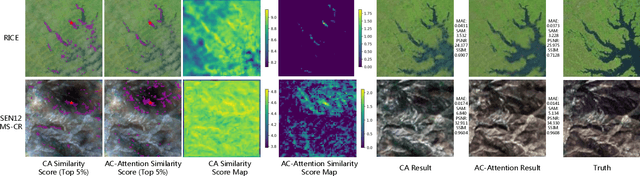
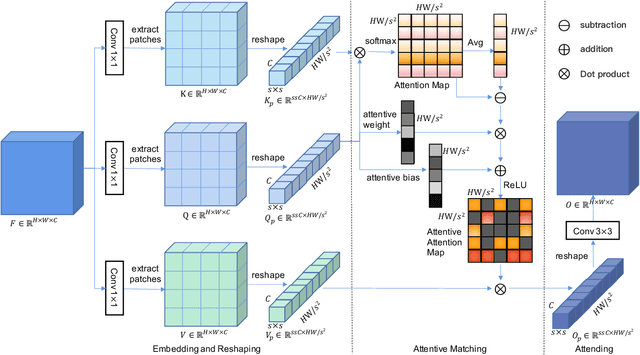
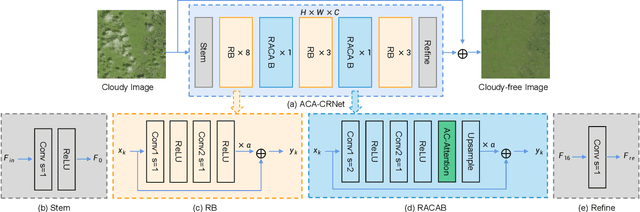
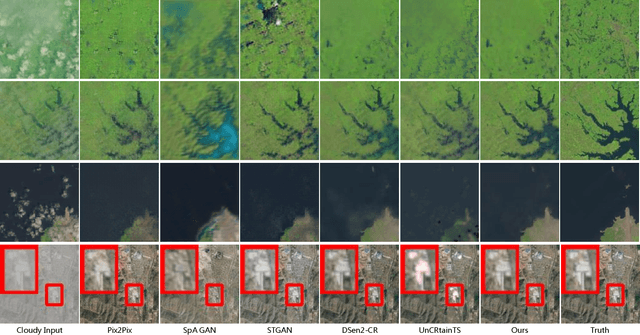
Cloud cover can significantly hinder the use of remote sensing images for Earth observation, prompting urgent advancements in cloud removal technology. Recently, deep learning strategies have shown strong potential in restoring cloud-obscured areas. These methods utilize convolution to extract intricate local features and attention mechanisms to gather long-range information, improving the overall comprehension of the scene. However, a common drawback of these approaches is that the resulting images often suffer from blurriness, artifacts, and inconsistencies. This is partly because attention mechanisms apply weights to all features based on generalized similarity scores, which can inadvertently introduce noise and irrelevant details from cloud-covered areas. To overcome this limitation and better capture relevant distant context, we introduce a novel approach named Attentive Contextual Attention (AC-Attention). This method enhances conventional attention mechanisms by dynamically learning data-driven attentive selection scores, enabling it to filter out noise and irrelevant features effectively. By integrating the AC-Attention module into the DSen2-CR cloud removal framework, we significantly improve the model's ability to capture essential distant information, leading to more effective cloud removal. Our extensive evaluation of various datasets shows that our method outperforms existing ones regarding image reconstruction quality. Additionally, we conducted ablation studies by integrating AC-Attention into multiple existing methods and widely used network architectures. These studies demonstrate the effectiveness and adaptability of AC-Attention and reveal its ability to focus on relevant features, thereby improving the overall performance of the networks. The code is available at \url{https://github.com/huangwenwenlili/ACA-CRNet}.
Semantic-aware Representation Learning for Homography Estimation
Jul 18, 2024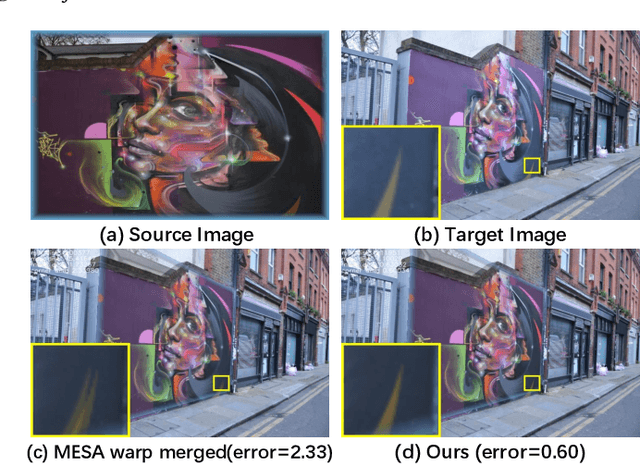

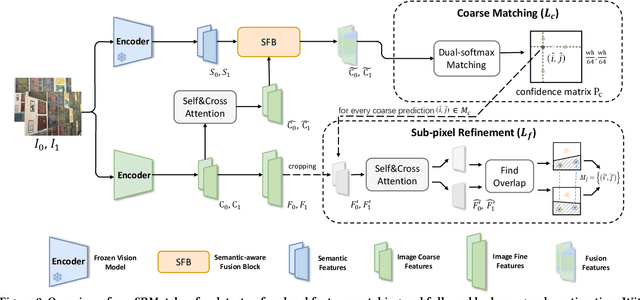

Homography estimation is the task of determining the transformation from an image pair. Our approach focuses on employing detector-free feature matching methods to address this issue. Previous work has underscored the importance of incorporating semantic information, however there still lacks an efficient way to utilize semantic information. Previous methods suffer from treating the semantics as a pre-processing, causing the utilization of semantics overly coarse-grained and lack adaptability when dealing with different tasks. In our work, we seek another way to use the semantic information, that is semantic-aware feature representation learning framework.Based on this, we propose SRMatcher, a new detector-free feature matching method, which encourages the network to learn integrated semantic feature representation.Specifically, to capture precise and rich semantics, we leverage the capabilities of recently popularized vision foundation models (VFMs) trained on extensive datasets. Then, a cross-images Semantic-aware Fusion Block (SFB) is proposed to integrate its fine-grained semantic features into the feature representation space. In this way, by reducing errors stemming from semantic inconsistencies in matching pairs, our proposed SRMatcher is able to deliver more accurate and realistic outcomes. Extensive experiments show that SRMatcher surpasses solid baselines and attains SOTA results on multiple real-world datasets. Compared to the previous SOTA approach GeoFormer, SRMatcher increases the area under the cumulative curve (AUC) by about 11\% on HPatches. Additionally, the SRMatcher could serve as a plug-and-play framework for other matching methods like LoFTR, yielding substantial precision improvement.
Camera-aware Label Refinement for Unsupervised Person Re-identification
Mar 25, 2024


Unsupervised person re-identification aims to retrieve images of a specified person without identity labels. Many recent unsupervised Re-ID approaches adopt clustering-based methods to measure cross-camera feature similarity to roughly divide images into clusters. They ignore the feature distribution discrepancy induced by camera domain gap, resulting in the unavoidable performance degradation. Camera information is usually available, and the feature distribution in the single camera usually focuses more on the appearance of the individual and has less intra-identity variance. Inspired by the observation, we introduce a \textbf{C}amera-\textbf{A}ware \textbf{L}abel \textbf{R}efinement~(CALR) framework that reduces camera discrepancy by clustering intra-camera similarity. Specifically, we employ intra-camera training to obtain reliable local pseudo labels within each camera, and then refine global labels generated by inter-camera clustering and train the discriminative model using more reliable global pseudo labels in a self-paced manner. Meanwhile, we develop a camera-alignment module to align feature distributions under different cameras, which could help deal with the camera variance further. Extensive experiments validate the superiority of our proposed method over state-of-the-art approaches. The code is accessible at https://github.com/leeBooMla/CALR.
Single-Shot and Multi-Shot Feature Learning for Multi-Object Tracking
Nov 17, 2023Multi-Object Tracking (MOT) remains a vital component of intelligent video analysis, which aims to locate targets and maintain a consistent identity for each target throughout a video sequence. Existing works usually learn a discriminative feature representation, such as motion and appearance, to associate the detections across frames, which are easily affected by mutual occlusion and background clutter in practice. In this paper, we propose a simple yet effective two-stage feature learning paradigm to jointly learn single-shot and multi-shot features for different targets, so as to achieve robust data association in the tracking process. For the detections without being associated, we design a novel single-shot feature learning module to extract discriminative features of each detection, which can efficiently associate targets between adjacent frames. For the tracklets being lost several frames, we design a novel multi-shot feature learning module to extract discriminative features of each tracklet, which can accurately refind these lost targets after a long period. Once equipped with a simple data association logic, the resulting VisualTracker can perform robust MOT based on the single-shot and multi-shot feature representations. Extensive experimental results demonstrate that our method has achieved significant improvements on MOT17 and MOT20 datasets while reaching state-of-the-art performance on DanceTrack dataset.
Understanding the Overfitting of the Episodic Meta-training
Jul 07, 2023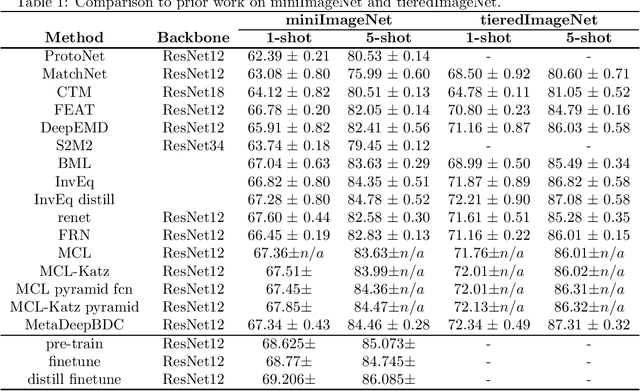
Despite the success of two-stage few-shot classification methods, in the episodic meta-training stage, the model suffers severe overfitting. We hypothesize that it is caused by over-discrimination, i.e., the model learns to over-rely on the superficial features that fit for base class discrimination while suppressing the novel class generalization. To penalize over-discrimination, we introduce knowledge distillation techniques to keep novel generalization knowledge from the teacher model during training. Specifically, we select the teacher model as the one with the best validation accuracy during meta-training and restrict the symmetric Kullback-Leibler (SKL) divergence between the output distribution of the linear classifier of the teacher model and that of the student model. This simple approach outperforms the standard meta-training process. We further propose the Nearest Neighbor Symmetric Kullback-Leibler (NNSKL) divergence for meta-training to push the limits of knowledge distillation techniques. NNSKL takes few-shot tasks as input and penalizes the output of the nearest neighbor classifier, which possesses an impact on the relationships between query embedding and support centers. By combining SKL and NNSKL in meta-training, the model achieves even better performance and surpasses state-of-the-art results on several benchmarks.